
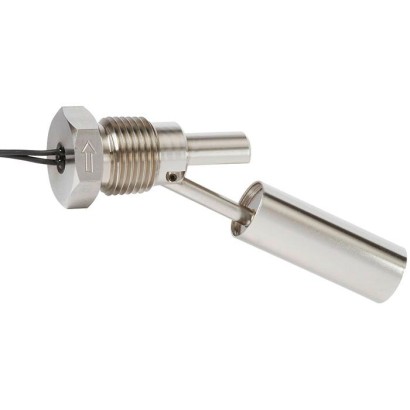
Float switch
Description
With its compact design, the model HLS-M float switch for horizontal installation in miniature design is ideally suited for use in small tanks, for indicating minimum/maximum levels.
The float is attached to a supported, swivelling lever and moves with the level of the medium being measured. By means of a permanent magnet, when a preset switch point is reached, a reed contact (inert gas contact) is actuated.
By using a magnet and reed contact the switching operation is non-contact, free from wear and needs no power supply.
The contacts are potential-free.
Fig. top: Plastic version, model HLS-M11 Fig. bottom: Stainless steel version, model HLS-M22
The switching function refers to a rising liquid level: Standard use as normally open contact (can be used as normally closed contact by a 180° rotation).
The float switch is simple to mount and maintenance-free, so the costs of mounting, commissioning and operation are low.
Special features
- Lateral installation in the tank
- Operating limits: Operating temperature: T = -40 ... +120 °C Operating pressure: P = 5 bar Limit density: ρ ≥ 800 kg/m 3
- Operating temperature: T = -40 ... +120 °C
- Operating pressure: P = 5 bar
- Limit density: ρ ≥ 800 kg/m 3
- Plastic and stainless steel versions
- Space-saving installation
- Switch consists of only one component
| Model | HLS-M11 |
| Product family | HLS-M |
| Subcategory | float switch |
| Process connection | Male thread G1/4"G1/41/2 NPTG1/8 |
| Process temperature | −10…+80 °C |
| Max process pressure | 1 bar |
| Measurement technology | float |
| Output signal | potential-free contact · normally open (can be used as normally closed) · normally open contact · can be used as normally closed contact by 180° rotation |
| Power supply | Safety extra-low voltage |
| Electrical connection | Cable connection PVC stranded wires, 2 x 0.5mm², Cable length 0.3m |
| Wetted parts material | Polypropylene, Stainless steel 1.4301 |
| Ambient temperature | −40…+120 °C |
| IP rating | IP65 |
| Certifications | RoHSCE |
| Datasheet languages | EN |
| Float switch model | Description | Installation | Electrical connection |
|---|---|---|---|
| HLS-M11 | Plastic version | From inside | Cable |
| HLS-M12 | Plastic version | From outside | Cable |
| HLS-M21 | Stainless steel version | From inside | Cable |
| HLS-M22 | Stainless steel version | From outside | Cable |
| HSL-M23 | Stainless steel version | From outside | Connector |
| Logo | Description | Country |
|---|---|---|
| EU declaration of conformity RoHS directive | European Union |
| Switching power Normally open contact (can be used as normally closed contact by a 180° rotation) | < AC 25 V; 25 VA; 0.5 A < DC 60 V; 25 W;0.5 A Attention: Operation only at safety extra-low voltage, e.g. with contact protection relay |
|---|---|
| Mounting position | Horizontal |
| Limit density | ≥ 800 kg/m 3 |
| Medium temperature | -10 …+80 °C |
| Ingress protection | IP65 |
| Max.operating pressure | 1 bar |
| Material | Polypropylene |
| Process connection | Male thread G1/4" |
| Mounting | For installation in the tank from inside |
| Float | Outer diameter15mm Length25mm |
| Electrical connection | Cable connection PVC stranded wires, 2 x 0.5mm 2 Cable length 0.3m |
| Order number | 117612 |
| Switching power Normally open contact (can be used as normally closed contact by a 180° rotation) | < AC 50 V; 25 VA; 0.5 A < DC 75 V; 25 W;0.5 A Attention: Operation only at safety extra-low voltage, e.g. with contact protection relay |
|---|---|
| Mounting position | Horizontal |
| Limit density | ≥ 800 kg/m 3 |
| Medium temperature | -40 …+120 °C |
| Ingress protection | IP65 |
| Max.operating pressure | 5 bar |
| Material | Stainless steel 1.4301 |
| Process connection | Male thread G1/8" |
| Mounting | For installation in the tank from inside |
| Float | Outer diameter17mm Length47mm |
| Electrical connection | Cable connection PVC stranded wires, 2 x 0.5mm 2 Cable length 0.5m |
| Order number | 118330 |
Couldn't find the answer in the documentation? An engineer will reply within a business day.
Ask an engineer →