
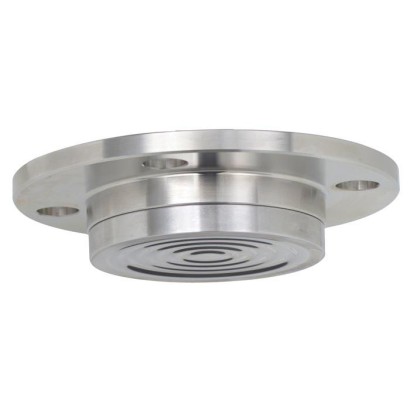
Diaphragm seal with sterile connection
Description
Diaphragm seals are used for the protection of pressure measuring instruments in applications with difficult media. In diaphragm seal systems, the diaphragm of the diaphragm seal effects the separation of the instrument and the medium. The pressure is transmitted to the measuring instrument via the system fill fluid which is inside the diaphragm seal system.
For the implementation of demanding customer applications, there is a wide variety of designs, materials and system fill fluids available.
For further technical information on diaphragm seals and diaphragm seal systems see IN 00.06 'Application, operating principle, designs'.
Thanks to its flush process connection, the model 990.17 diaphragm seal is optimally suited for installation in storage tanks. With a suitable welding flange, this diaphragm seal can
Diaphragm seal with sterile connection, model 990.17
be integrated into any type of tank or vessel. Level measurement with diaphragm seals also works with media that, due to the process, are under pressure and have high or low viscosity.
The model 990.17 diaphragm seal is particularly suitable for CIP cleaning processes as it meets the requirements for elevated temperatures and chemical resistance to cleaning solutions.
Mounting of the diaphragm seal to the measuring instrument may be made via a direct connection, for high temperatures via a cooling element or via a flexible capillary.
For the material selection WIKA offers a variety of solutions, in which the diaphragm seal and the wetted parts can be made of identical or different materials. The wetted parts can, as an alternative, be electropolished.
Special features
- Flush, aseptic process connection
- Dead-space free installation
- Suitable for SIP and CIP
- 3-A compliant
- Rotatable retainer flange
| Model | 990.17 |
| Product family | 990 |
| Subcategory | Diaphragm seal |
| Pressure ranges | 0…40 bar · 0…580 psi · 0…1 bar · 0…14.5 psi |
| Process connection | DRD |
| Case material | Stainless steel 1.4435 (316L) |
| Wetted parts material | Stainless steel 1.4435 (316L) |
| Certifications | 3-ACRNEACCEPressure equipment directiveMTSCHS |
| Datasheet languages | EN |
| Model 990.17 | Standard | Option |
|---|---|---|
| Pressure range | 0 ... 1 bar to 0 ... 40 bar [0 ... 14.5 psi to 0 ... 580 psi] or all other equivalent vacuum or combined pressure and vacuum ranges | |
| Level of cleanliness of wetted parts | Oil and grease free per ASTM G93-03 level F WIKA standard (< 1,000 mg/m²) | ■ Oil and grease free per ASTM G93-03 level C and ISO 15001 (< 66 mg/m²) ■ Oil and grease free per ASTM G93-03 level D and ISO 15001 (< 220 mg/m2) |
| Origin of wetted parts | International | EU, CH, USA |
| Surface roughness of wetted parts | Ra ≤ 0.76 μm per ASME BPE SF3 (except for weld seam) | Ra ≤ 0.38 μm per ASME BPE SF4, only with elec - tropolished surface (except for weld seam) |
| Material | Stainless steel 1.4435 (316L) | - |
| Connection to the measuring instrument | Axial gauge adapter | Axial gauge adapter with G1/2, G1/4, 1/2 NPT or 1/4 NPT (female) |
| Type of mounting | Direct mounting | ■ Capillary ■ Cooling element |
| Vacuum service (see IN 00.25) | Basic service | ■ Premium service ■ Advanced service |
| Assembly parts | ■ Retainer flange, stainless steel 1.4435 (316L) ■ Hexagon screws M10 x 20, stainless steel | Welding flange for DRD connection, stainless steel 1.4435 (316L) |
| Marking of the diaphragm seal | - | Per valid 3-A standard |
| Instrument mounting bracket (only for capillary option) | - | ■ Form H per DIN 16281, 100 mm, aluminium, black ■ Form H per DIN 16281, 100 mm, stainless steel ■ Bracket for pipe mounting, for pipe Ø20 ... 80 mm, steel (see data sheet AC 09.07) |
| Logo | Description | Country |
|---|---|---|
| EU declaration of conformity Pressure equipment directive | European Union | |
| EAC (option) Pressure equipment directive | Eurasian Economic Community | |
| ® | 3-A Sanitary Standard | USA |
| - | CRN Safety (e.g. electr. safety, overpressure, ...) | Canada |
| - | MTSCHS (option) Permission for commissioning | Kazakhstan |
| Material | Unified numbering system (UNS) |
|---|---|
| Stainless steel 316L (1.4404 or 1.4435) | S31603 |
| Stainless steel 904L (1.4539) | N08904 |
| Stainless steel 321 (1.4541) | S32100 |
| Stainless steel 316Ti (1.4571) | S31635 |
| Stainless steel 1.4466 (urea grade) | S31050 |
| Duplex 2205 (1.4462) | S31803 |
| Superduplex 1.4410 | S32750 |
| Tantalum (also lining) | R05200 |
| Hastelloy C276 (2.4819) | N01276 |
| Hastelloy C22 (2.4602) | N06022 |
| Inconel 600 (2.4816) | N06600 |
| Incoloy 825 (2.4858) | N08825 |
| Inconel 625 (2.485) | N06625 |
| Monel 400 (2.4360) | N04400 |
| Nickel 200 (2.4066) | N02200 |
| Nickel 201 (2.4068) | N02201 |
| Titanium 3.7035 (class 2) | R50400 |
| Titanium 3.7235 (class 7) | R52400 |
| Zirconium GR702 | R60702 |
| Designation | Identi- fication number | Solidi- fication point | Boiling/ degradation point | Density at 25 °C | Kin.Viscosity at 25 °C | Remark |
|---|---|---|---|---|---|---|
| KN | °C | °C | g/cm³ | cSt | ||
| Silicone oil | 2 | -45 | +300 | 0.96 | 54.5 | Universal application |
| Glycerine | 7 | -35 | +240 | 1.26 | 759.6 | FDA 21 CFR 182.1320 |
| Silicone oil | 17 | -90 | +200 | 0.92 | 4.4 | Low temperatures |
| Halocarbon | 21 | -60 | +175 | 1.89 | 10.6 | Oxygen 1) and chlorine |
| Methylcyclopentane | 30 | -130 | +60 | 0.74 | 0.7 | For very low temperatures |
| High-temperature silicone oil | 32 | -25 | +400 | 1.06 | 47.1 | For high temperatures |
| Neobee® M-20 | 59 | -35 | +260 | 0.92 | 10.0 | FDA 21 CFR 172.856, 21 CFR 174.5 |
| DI water | 64 | +4 | +85 | 1.00 | 0.9 | For ultrapure media |
| Silicone oil | 68 | -75 | +250 | 0.93 | 10.3 | |
| DI water/propanol mixture | 75 | -30 | +60 | 0.92 | 3.6 | For ultrapure media |
| Medicinal white mineral oil | 92 | -15 | +260 | 0.85 | 45.3 | FDA 21 CFR 172.878, 21 CFR 178.3620(a); USP, EP, SP |
View all (5)
| Maximum temperature | Maximum oxygen pressure |
|---|---|
| to 60 °C | 50 bar |
| > 60 °C to 100 °C | 30 bar |
| > 100 °C to 175 °C | 25 bar |
Couldn't find the answer in the documentation? An engineer will reply within a business day.
Ask an engineer →